
Cross-industry
When every input moves
Why productivity is becoming the defining strategic capability in food and beverage
Economic pressure isn’t just cyclical anymore. It’s systemic — and it’s forcing food and beverage leaders to rethink how their organization creates value inside the factory.
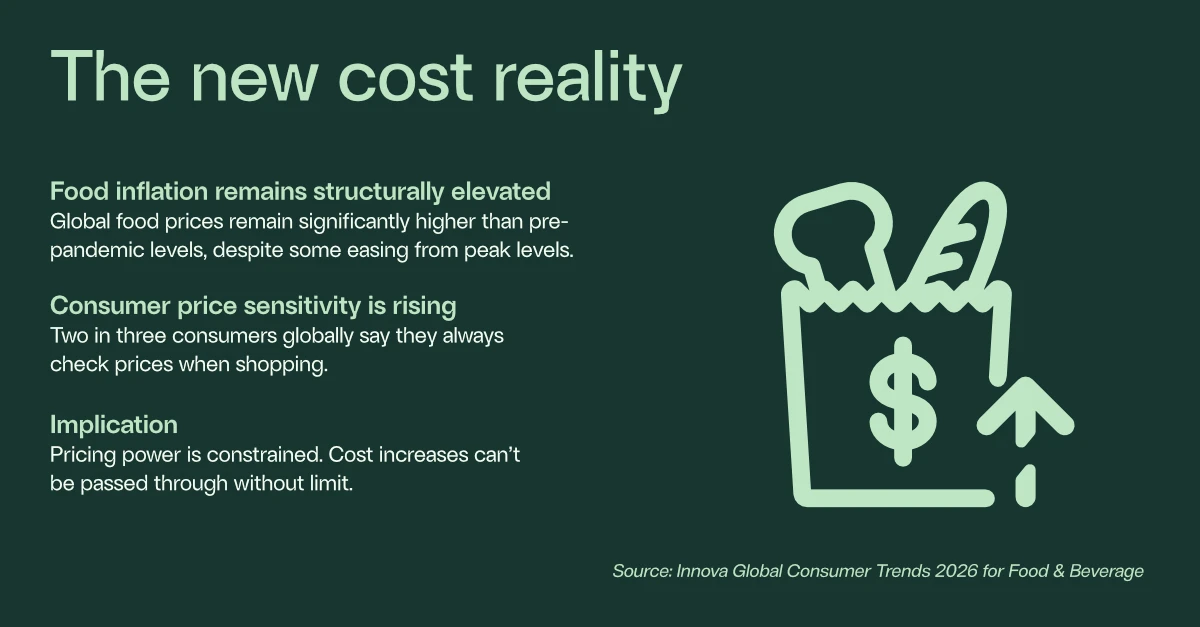
For years, the industry managed cost pressure through predictable cycles: commodity prices rise, margins compress, producers react and eventually markets rebalance. That rhythm has broken down. Today’s pressures move faster, reach further, and interact in ways that are harder to predict.
46 percent of C-suite executives say their company has shortened its strategic planning horizons1 — a clear sign that volatility is no longer episodic, but a structural condition leaders must manage.
"The key shift is that pressures don’t stay where they start," says Thomas Skaaning, SVP for Dairy at Novonesis. "This isn’t a temporary disruption, it’s a structural change in how cost behaves — and it’s forcing a fundamental rethink of how we operate in the industry."
Why isolated cost management no longer works
At a glance, today’s environment appears to be about rising costs. At a deeper level, it’s about volatility within the cost stack itself.
Energy is the clearest example. As oil and gas prices shift, they influence packaging materials derived from petrochemicals, the cost of fertilizers in agriculture and ultimately the price and availability of core raw materials. In dairy, this creates a direct chain: higher feed costs translate into higher milk costs, which then cascade into processing and finished product economics.
"It behaves like a delayed chain reaction," Skaaning explains. "You see step-by-step effects through the system — it doesn’t hit all at once, but it keeps moving."
The consequence is clear: producers can no longer manage cost as isolated variables. They must understand and manage it as a system.
Productivity as the primary strategic lever
That shift — from cost control to productivity — is becoming the defining response.
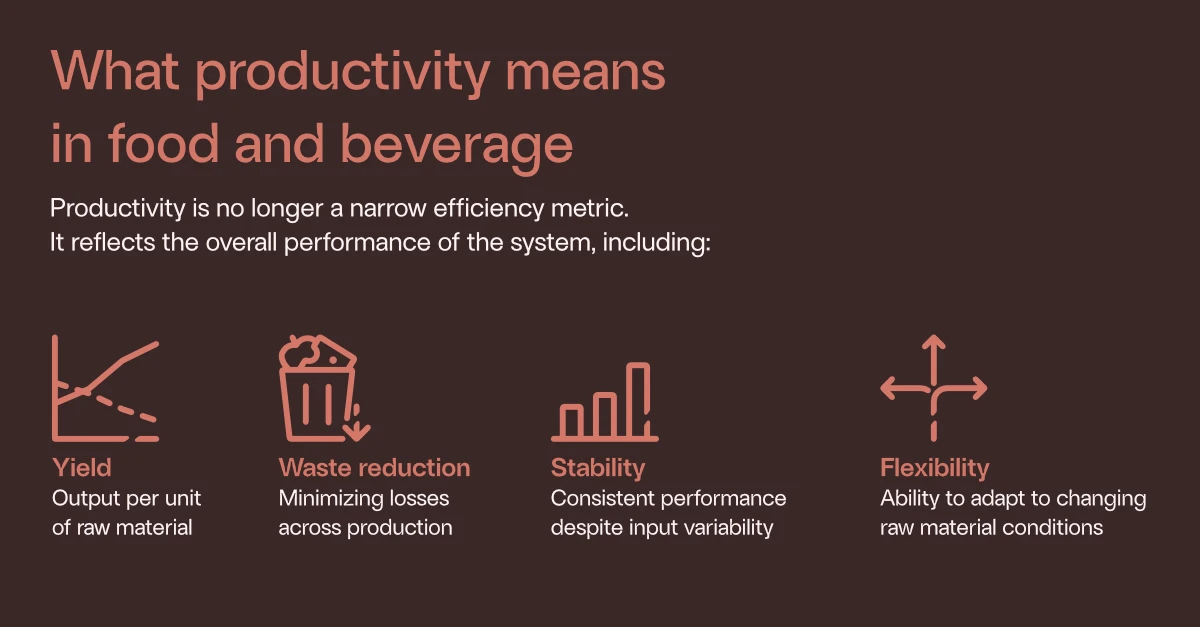
Across categories, focus is moving toward extracting more value from existing inputs. The emphasis isn’t on replacing the cost stack, but on improving how efficiently it is converted into output. In this context, productivity means getting more saleable output from the same raw material base, reducing losses, stabilizing performance, and increasing flexibility when inputs change.
"We see customers coming with a very clear question: how do we get more out of less?" Skaaning notes.
In operational terms, this manifests in interconnected priorities:
- Increasing yield from raw materials
- Reducing waste and production losses
- Improving process stability to avoid variability
- Simplifying formulations to reduce exposure to volatile inputs
"This is work the industry has always done," Skaaning says. "But in this environment, productivity becomes much more important. It becomes the main lever."
Why dairy is leading this strategic shift
Dairy offers a particularly clear illustration of what this shift looks like in practice.
Its economics are inherently tied to conversion efficiency. Milk is both the primary input and a volatile cost driver, shaped by feed, energy, and agricultural conditions. Small improvements in how that milk is utilized — whether in cheese production, fermentation, or shelf life — can translate into significant financial impact, especially at scale.
This dynamic has pushed dairy producers to focus intensely on productivity. What’s happening in dairy is now increasingly relevant across other categories. In baking, producers are working to improve dough consistency and extend shelf life to minimize waste. In beverages, operators are focused on increasing throughput and reducing batch variability. Across the board, efficiency inside the process is often the only lever left when inputs and pricing are constrained.
Efficiency is becoming the new innovation
This shift is also reshaping how producers define innovation.
In growth periods, innovation focuses outward — new products, formats, and consumer propositions. Under pressure, it increasingly turns inward toward the system itself.
“Process improvements that increase throughput or improve freshness over shelf life are gaining importance,” says Skaaning, “at the same time, stability and predictability take on more strategic weight.”
For leadership teams, this implies a different kind of innovation pipeline — one focused on measurable operational impact, not just market differentiation.
The real battleground: predictability
If there’s a single capability emerging as critical, it isn’t cost reduction. It’s predictability.
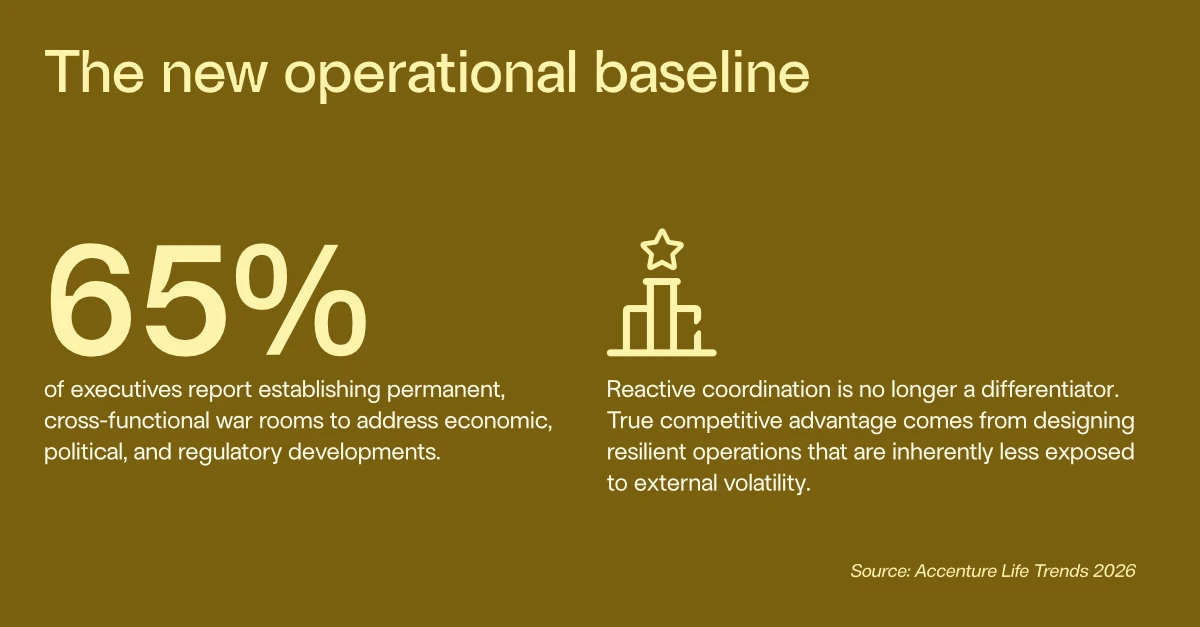
This reality is already forcing organizations to adapt, with 65 percent of executives reporting they have set up a permanent, cross-functional war room or rapid response unit to address economic, political, and regulatory developments2. While necessary, this level of reactive coordination does not create lasting competitive advantage.
The real edge doesn’t come from responding faster to external shocks — it comes from designing operations that are less exposed to them.
"The companies that perform best are the ones that can remove some of the volatility from their own processes," Skaaning says.
In practical terms, that means designing operations that:
- Deliver consistent output even when inputs vary
- Reduce dependency on the most volatile components
- Maintain quality while improving efficiency
"If you can take some of that uncertainty out of your own system, you’re much better positioned to handle the uncertainty outside it,” explains Skaaning. “And this is where biology steps in."
The key to next-generation efficiency
Biosolutions directly support this new mandate for operational resilience. By harnessing cultures and enzymes, producers can unlock significant yield improvements and reduce production waste.
"Biology allows for greater process stability and freshness over shelf life, ensuring more products reach the consumer exactly as intended," explains Skaaning.
Just as importantly, biosolutions introduce raw material flexibility, helping producers adapt to volatile input conditions while not only protecting quality, but often improving it.
In many cases, the same productivity gains also support better taste, texture, clean-label appeal, health, freshness, and nutritional value — creating products consumers genuinely love.
It also helps create a buffer on price, supporting affordability for consumers in addition to productivity for producers.
That combined impact is what makes biosolutions especially powerful in today’s environment.
At a time when everything moves, competitive advantage won’t come from reacting faster. It will come from building resilience into operations — so you’re less affected by volatility in the first place.
Sources
- Accenture Life Trends 2026
- Innova Global Consumer Trends 2026 for Food & Beverage
- IMF Food Price Index (via Innova)
- Novonesis customer insights
About Thomas Skaaning
Thomas Skaaning is Senior Vice President and Segment Lead for Dairy at Novonesis, where he shapes the global strategy for the dairy business. With a background in biotechnology, Thomas has built his career over more than three decades in the food ingredients industry — starting in research and development roles before moving into application, regional business management in APAC and Europe, and successive global leadership positions across marketing, commercial development, applied research, and category strategy in dairy. Follow Thomas.

Make the world of food and beverages better with biology
Find out more about how you can harness and amplify the power of cultures and enzymes with our biosolutions, so you can make the world of food and beverages even better with biology.