Cheese
What is the best rennet for cheese yield?
While yield is a key consideration driving rennet choice, there are other considerations. Your choice of rennet also influences the texture and functionality of your cheese, as well as whey quality. And you need a product that matches your end market requirements. This article compares various rennet types across all these parameters.
What is rennet?
First things first: let’s take a look at what rennet is and its history in cheesemaking. Rennet, also called rennin, is a mixture of chymosin and pepsin. Chymosin is a naturally-occurring protease enzyme that breaks down protein. This breakdown coagulates the milk, causing it to separate into curds (solids) and whey (liquid). Since ancient times, people have extracted rennet from the gastric mucosa of the stomach of young mammals. The most common source of animal rennet is calves' stomachs. Because of their role in milk coagulation, rennets are also called coagulants.

How coagulants work
Milk is made up of fat globules, casein micelles, lactose, whey proteins, minerals and other components. Casein micelles are a protein complex made up of core, alpha and beta casein and a hairy surface of kappa caseins. Ideally, rennet should act very specifically on these hairy kappa caseins. Breaking these down destabilizes the casein micelles. The destabilized micelles then merge to form a three-dimensional protein matrix. This protein matrix acts as a net, trapping fat globules to form curds. The more fat and protein in the curds, the higher the cheese yield.
C/P ratio: the key to specificity
Chymosin is a highly-specific enzyme that breaks down kappa casein almost exclusively. However, certain types of coagulants may also contain a second enzyme, called pepsin. This is non-specific, targeting a broad range of proteins. This broader breakdown leads to excess proteolysis, which negatively impacts the formation of the protein matrix. The result is that more fat and protein end up in the whey instead of the curd, directly reducing cheese yields. In essence, the curd doesn’t retain as much of the milk’s protein/fat because pepsin “overcuts” the curd. Excess proteolysis can also cause bitterness. That’s why coagulants are measured on their C/P ratio. This is the balance between a coagulant's clotting activity (C: precise breakdown of kappa-casein) and its general proteolytic activity (P: non-specific breakdown of other proteins). A higher C/P ratio results in a stronger protein matrix, lower fat and protein losses into the whey, higher yields and less bitterness.
Fermentation-produced chymosin: the gold standard for yield
Fermentation-produced chymosin (FPC) is an enzyme produced by fermentation that’s structurally identical to chymosin. It’s the most-used coagulant in industrial cheesemaking today. The market-leading FPC has an unmatched C/P ratio of 80. This high C/P ratio has led to it being described as “the world’s most specific coagulant”. This specificity leads to high yields. And – crucially – it also positively impacts whey and cheese quality.
Higher quality whey, improved functionality
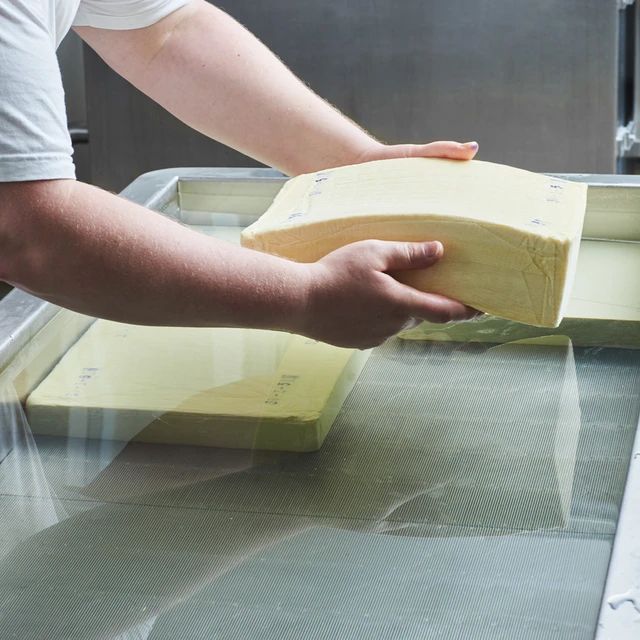
Whey brings a lot of value to the modern cheesemaking process, so it’s essential for cheesemakers to meet whey processors’ needs. Generally, processors look for a cleaner whey with less sediments and fat. They also want to avoid protein fractions other than true whey protein. By supporting a stronger protein matrix, highly-specific coagulants reduce fat and protein losses into the whey. That helps you achieve the high-quality whey processors want. Firmness, stickiness, shreddability, sliceability and shelf life are all impacted by coagulant choice. A coagulant with higher proteolytic activity will negatively impact all these functionality parameters. With a highly-specific coagulant, you can achieve an optimal texture for converting to other formats.
Microbial coagulants: supporting specialty production
Microbial coagulants are another option available to cheesemakers. These coagulants are ideal for organic, vegetarian, halal, kosher and VLOG cheese production. They’re a great option for cheesemakers who need to meet specific labeling requirements. While they can’t yet match FPC, the latest generation of microbial coagulants has narrowed the specificity gap. These products have up to three times higher C/P ratios than first generation microbial coagulants.
Animal rennet for heritage cheeses
For many heritage cheesemakers, animal rennets are still the coagulant of choice. They enable high-quality, traditional cheeses with intense, authentic flavors. Today, around 10% of cheese is produced with animal rennet1, with Italy and France the main markets. In these countries, animal rennet allows cheesemakers to meet labeling requirements for Denominazione di Origine Protetta (DOP) and Appellation d'Origine Contrôlée (AOC). Modern animal rennet producers work to develop portfolios with a range of chymosin-to-pepsin ratios. That allows heritage cheesemakers to tailor flavor development and ripening characteristics to their unique cheese varieties.
Choose the best coagulant for your goals
No single coagulant is right for every situation. The best choice for you depends on your production goals, market requirements and desired cheese characteristics. If maximizing cheese yield is your primary objective, FPC is the best choice. Its exceptional specificity makes it the gold standard for yields. It supports stronger casein networks, improved retention of fat and protein and better whey quality. Microbial coagulants help producers meet organic, vegetarian and other specialty labeling requirements. And animal rennet remains essential for many heritage and protected-origin cheeses.
Looking for the best coagulant for your goals? Let’s find it together.
By Sebastien Roustel, Head of Applied Research, Cheese Denmark, Novonesis
Sebastien is a senior expert in cheese science and dairy innovation, with extensive experience spanning research, application development, and industrial strategy. In leadership roles including Associated Director of Cheese Applications, and Senior Principal Scientist, he has guided scientific and technological direction and managed large, cross‑functional teams. With deep expertise across all cheese types, Sebastien combines strong technical knowledge with practical industry insight, covering product characterization, culture and enzyme applications, and milk optimizations. His career also involves lecturing, publications, and directing R&D at École Nationale de l'Industrie Laitière et Biotechnologies (ENILEA of Poligny/Mamirolle) and serving on the editorial board of Techniques de l’Ingénieur and Profession Fromager journals, with more than 100 publications.