

Fermented milk
Are yogurt cultures probiotics?
Yogurt has long been associated with “good bacteria”. For many consumers, that has led to a simple assumption: if a yogurt contains live cultures, it must contain probiotics. As a result, the distinction between starter vs probiotic culture is often blurred in everyday communications, creating fertile ground for confusion.
Communicate for strategic advantage
In reality, the question “are yogurt cultures probiotics?” has a clear scientific answer. And this answer is critical to how brands communicate, differentiate and build trust in a heavily regulated category. With the right communication, you can gain a strategic advantage for new market entry, partnerships and brand positioning.
Why the confusion exists
Yogurt and other fermented milk products are made using live bacterial cultures. These cultures are essential to fermentation. They transform milk into yogurt, quark, kefir, skyr, dahi/curd and other fermented milk products. In doing so, they create tastes and texture people love. And it's here that the confusion arises. A global study1 showed that while 65% of consumers have at least a basic understanding of fermentation, only 21% say they fully understand what fermentation means. And the same global study showed that many consumers may already associate fermented milk products with digestive health, probiotics and “good bacteria”2.
“Fermented drinks help strengthen the immune system and provide good bacteria for the intestinal flora.” 35-year-old French female consumer
The same study showed that while consumers broadly recognize that probiotics are good for gut health, most lack awareness of specific strains and required amounts.
Satisfaction increases with knowledge
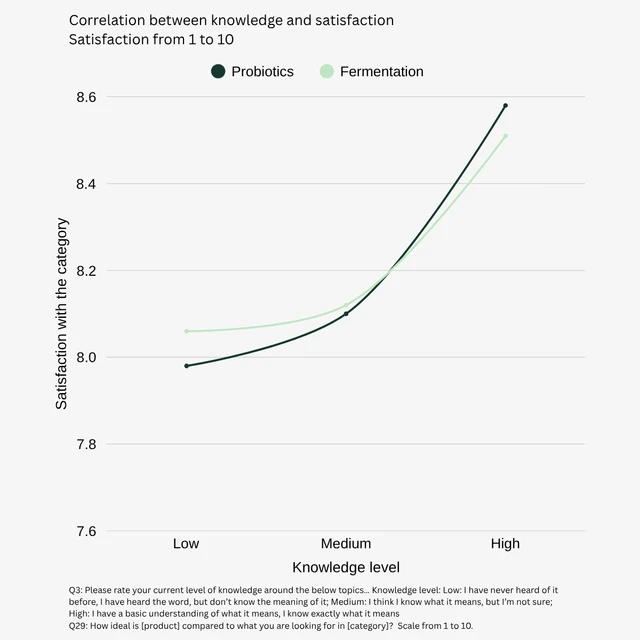
The global study highlighted the importance of clear, science-based communication in capturing market share. Because as consumers become more informed about probiotics and fermentation, their satisfaction with products in the categories increases. As shown here, consumers with low knowledge — those who’ve never heard of probiotics or don’t understand the term — report satisfaction levels around 7.98. Those with a medium understanding — who think they know but aren’t sure — show slightly higher satisfaction: 8.10.
But the biggest jump comes from consumers with high knowledge—those who either have a basic understanding or know exactly what probiotics are. Their satisfaction rises to 8.58. These knowledge and satisfaction levels are closely mirrored in fermentation. This trend tells us something important: awareness and education drives value perception. When consumers understand what probiotics and fermentation are and how they benefit health, they’re more likely to feel satisfied with the products they choose.
What defines a probiotic?
Probiotic is not a generic term for live bacteria. The word has a clear and internationally-recognized definition. According to the FAO and WHO3, probiotics are live microorganisms that, when administered in adequate amounts, confer a health benefit on the host. Importantly, probiotic effects are strain-specific. Benefits shown for one strain cannot be assumed for another - even within the same species. Based on this definition, three essential requirements must be in place for food and drinks to claim true probiotic benefits:
- Live: products must deliver live bacteria throughout shelf life.
- Adequate amounts: the amounts should be linked to the beneficial effect for which there is clinical documentation. Typically, amounts are 109 Colony Forming Units (CFU) as daily intake.
- Health benefit: strain-specific benefits must be documented in clinical trials; gastrointestinal health and immune function are the most-studied areas to date.
Starter vs probiotic culture: what’s the difference?
Products positioned as probiotics must meet the three essential requirements outlined above. Without these requirements, there is no scientific basis on which to communicate a probiotic effect.
Starter cultures, by contrast, are selected for their ability to perform a role in food production. In yogurt, they drive fermentation and help deliver consistent taste and texture. So while many yogurts contain live cultures, live bacteria alone do not qualify a product as probiotic. So not all yogurt cultures have proven health benefits.
Science-based communications to improve understanding
So the answer to the question “are yogurt cultures probiotics?” is actually quite simple. Because while all probiotics are cultures, not all cultures meet the necessary criteria to be called probiotics. And although this distinction between starter vs probiotic culture is very clear in science and regulation, it’s often less clear in day-to-day communications. Global data shows that consumer satisfaction with fermented milk products increases as understanding improves. So with clear, science-based communication about probiotics in yogurt and other fermented milk products, you can take the industry — and your business — to the next level.
By Søren Lindberg Harting, Global Marketing and Business Development Manager at Novonesis
With experience across biotechnology, life science, and MedTech, Søren specializes in marketing, business development and commercial strategy, turning market insights into growth opportunities. Before Novonesis, he held commercial and sales roles at GN Hearing and Boehringer Ingelheim, driving portfolio development, brand management, sales, and strategic positioning across complex healthcare and biotechnology portfolios. He holds an M.Sc. in International Business from Copenhagen Business School and has also studied at Harvard University and Monash University. Follow Søren.

Connect with our team to explore how you can communicate with confidence in the probiotics space.