
Fermented milk
How protective cultures help extend yogurt shelf life naturally
Yogurt with simpler, shorter labels creates new opportunities but also new challenges. Consumers’ expectations for products with simpler, shorter labels that don’t compromise on quality or shelf life is growing. That’s why extending shelf life naturally is becoming a key priority for yogurt producers.
How shelf life affects consumer perceptions
Shelf life affects consumer trust and confidence, product quality and waste reduction. It can shape how far a product can travel, how long it can be enjoyed by consumers and how strongly it can support premium positioning. That’s why strategies designed to extend yogurt shelf life naturally matter well beyond the plant floor.
This article examines:
• why yogurts are vulnerable to yeast and mold
• what fermentation-enabled bioprotection is and how it works
• How food cultures with bioprotective effect fit within a fermentation-based approach to yogurt shelf-life extension
• why shelf-life extension also matters for sustainability
Read on to find out more about solutions that support both shelf-life performance and simpler-label ambitions. And find out how these solutions can help take your yogurt brands to the next level.
Why yogurts are vulnerable to yeast and mold
Yeast and mold are commonplace in a range of environments. So it’s no surprise that they’re the most common causes of spoilage in fermented milk products. Yogurt is generally considered microbiologically stable because fermentation lowers pH and introduces competitive lactic acid bacteria. These contribute to a controlled microbial environment. Despite these hurdles however, yeast and mold contamination are very persistent and can still develop over time. Yogurt producers work to control fungal spoilage through process control and strict hygiene practices. The inclusion of ingredients such as potassium sorbate may also help to keep yogurt fresh. As consumer demand shifts towards simpler labels, you may be looking for ways to help extend yogurt shelf life naturally. A shorter, simpler label can help strengthen product appeal. But only if the product experience stays consistent from production through consumption. With fermentation-enabled bioprotective cultures, yogurt brands can find that balance.
What are fermentation-enabled protective cultures in yogurt
Fermentation-enabled bioprotection is the use of natural food cultures to enhance sanitation programs. It builds on fermentation’s traditional role as a natural process that helps to create a positive ecosystem. Certain food cultures with bioprotective effects are selected specifically for fermented milk applications, including yogurt. These cultures consist of strains of lactic acid bacteria which are added so they can take part in fermentation to reduce the risk of yeast and mold. Through multiple effects, they support extended shelf life. And because they work within the fermentation process as food cultures and are labeled together with existing cultures on product label, they help you meet consumer demand for simpler, shorter labels.
How do fermentation-enabled protective cultures work in yogurt?
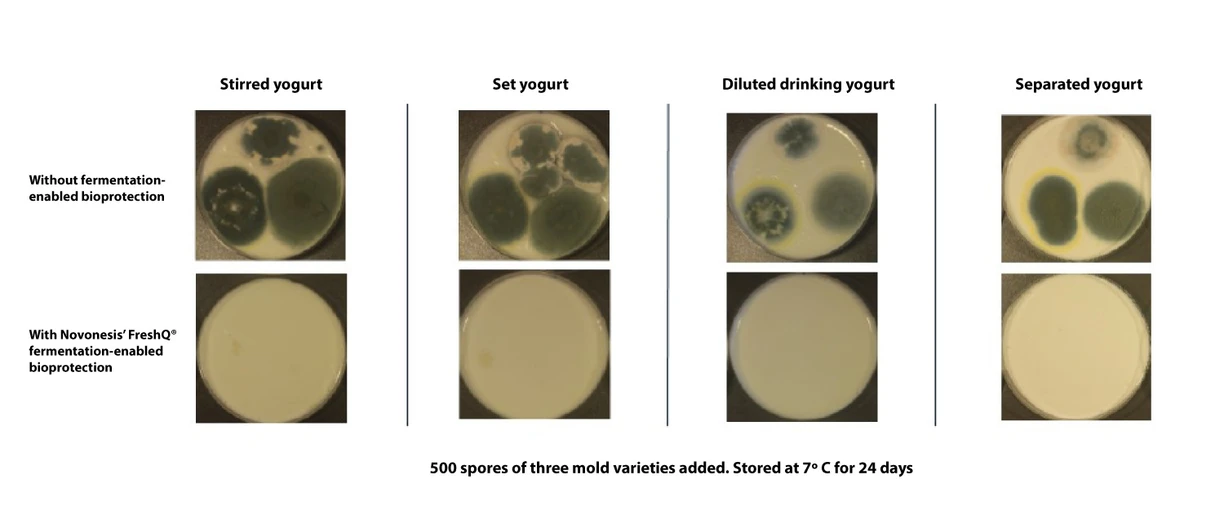
Fermentation-enabled bioprotection relies on multiple modes of action. A key mode of action is competition for nutrients, especially manganese. Manganese is essential for yeast and mold growth, and is present in milk at very low levels. Certain lactic acid bacteria used in food cultures with bioprotective effects actively and efficiently absorb manganese once the milk acidifies. That makes the manganese less available to spoilage organisms. Food cultures with bioprotective effects in yogurt also produce a range of compounds that contribute to a positive ecosystem. These include lactic and other small organic acids as well as other natural metabolites and volatiles. Within the fermentation process, these multiple modes of action help in creating a less favorable environment for yeast and mold growth. That helps you extend yogurt shelf life naturally across a broad range of yogurt types, as shown below.
What value could a few extra days of shelf life unlock for your business?
By helping to extend shelf life naturally, food cultures with bioprotective effects unlock a range of benefits. Longer shelf life gives you greater flexibility in production. It enables larger and less frequent batches, so you optimize capacity and reduce waste. It also supports greater transport flexibility and allows your products to travel further. That creates the potential to reach new markets that were previously out of reach. At retail level, it helps improve on-shelf availability and reduces the pressure of short-dated products. It also contributes to lowering food waste — one of the dairy industry’s most pressing challenges. Ultimately, this creates benefits across the entire value chain.
To discover all the benefits even a few extra days shelf life can bring, download our whitepaper and find out how you can turn days into value.

How protective cultures fit within a fermentation-based approach to yogurt shelf-life extension
Bioprotective cultures and potassium sorbate are both used to help extend shelf life, but they function in very different ways. Potassium sorbate is typically applied as a single, targeted solution within a formulation. In contrast, bioprotective cultures are part of a fermentation-based approach. This approach operates through multiple, naturally-occurring modes of action within a controlled ecosystem. This multi-factor activity continues throughout fermentation and into the final product. That helps to maintain freshness and sensory properties during shelf life. As part of a broader process, fermentation-enabled bioprotection can support simpler recipes.
Shelf-life extension as a sustainability lever in dairy
Globally, food that’s produced but never eaten accounts for up to 10% of emissions , 30% of land use and one-quarter of our water supply . Dairy is a key contributor to this, with 20% of all dairy wasted globally . And shelf-life-related issues are estimated to play a role in 80% of this waste . Bioprotective cultures can help to combat this by delaying yeast and mold growth in yogurt by up to seven days. That improves product robustness during distribution and storage. It also reduces the number of products discarded before they can be consumed, which helps to get you closer to your sustainability goals.
Moving simpler label yogurt forward
Simpler label yogurt offers a clear opportunity, but it also calls for a robust shelf-life strategy. Although yogurt’s low pH and lactic acid bacteria create important barriers to spoilage, yeast and mold can still develop over time. Bioprotective cultures use a process that exists in nature to help keep fermented milk products fresh. That gives you a simpler-label pathway to strong shelf-life performance.
By Florian Sanchez, Business Unit Director for Dairy Bioprotection at Novonesis
Florian Sanchez is Business Unit Director for Dairy Bioprotection at Novonesis, where he leads global strategy and commercial development to tackle food waste through biosolutions. His career spans roles at Novonesis, Puratos and Kerry, giving him extensive experience across dairy, bakery, and functional food ingredients. With a background in food engineering, he combines technical expertise with a strong track record in business development and product innovation. This blend of scientific knowledge and commercial leadership gives him a broad perspective on sustainable food production and evolving market needs. Follow Florian.

Get in touch to find out more about next-level shelf-life extension for yogurt.