Enhancing production and quality in Europe
Degumming of rapeseed/canola oil
Rapeseed oil is a major feedstock for vegetable oil production in Europe. The degumming process of rapeseed oil plays a crucial role in enhancing the quality and yield. In this article, we will delve into the key aspects of rapeseed oil production, challenges in degumming, and the advancements in enzymatic degumming techniques.
Rapeseed dominates Europe’s oil industry
According to data provided by the European Commission, 9.7M tonnes of 16.6M tonnes of vegetable oil output in 2025/2026(p) was rapeseed oil – DG Agri Dashboard for Oilseeds
59%
of Europe's vegetable oil produced is derived from rapeseed, making it a vital contributor to the region's vegetable oil output.
Quality starts with degumming
Rapeseed oil is supplied to various sectors for food processing, biodiesel production, and industrial usage. Before that, producers must ensure that the oil meets specifications on phosphorous content, moisture, impurities, and color. To meet the criteria, crude rapeseed oil needs to undergo a key refining process step: degumming.
Degumming involves the removal of phospholipids — commonly referred to as "gums" due to their ability to emulsify water and oil. This process is essential not only for improving the oil’s stability but also for:
- preventing operational disruptions during downstream processes (e.g. bleaching and deodorization)
- avoiding hazardous conditions during storage and transport
- enhancing the oil’s overall shelf life and quality
Challenges in rapeseed oil degumming
Rapeseed oil presents unique challenges during the degumming process, compared to other vegetable oils, such as soybean oil. This is because it contains a higher amount of non-hydratable phospholipids (NHPs), which are bound to metal ions. This requires more intensive degumming methods, such as acid degumming, to ensure effective removal of gums.
While acid degumming is effective, it does not eliminate all NHPs and produces by-products that limit potential oil yield. This can result in unrealized economic benefits.
Enzymatic degumming of rapeseed oil
This is where enzyme-assisted degumming comes in. Enzymatic degumming of rapeseed oil involves the use of specific enzymes to selectively target the phospholipids. The enzymes modify the structure of the phospholipids, providing a more efficient separation, improving oil quality and increasing the oil yield. Enzymatic degumming also offers a more sustainable and environmentally friendly approach compared to traditional methods, as it reduces the need for harsh chemicals, excessive water usage and waste handling.
The benefits of enzymatic degumming of rapeseed oil are evident in both industrial and laboratory trials.
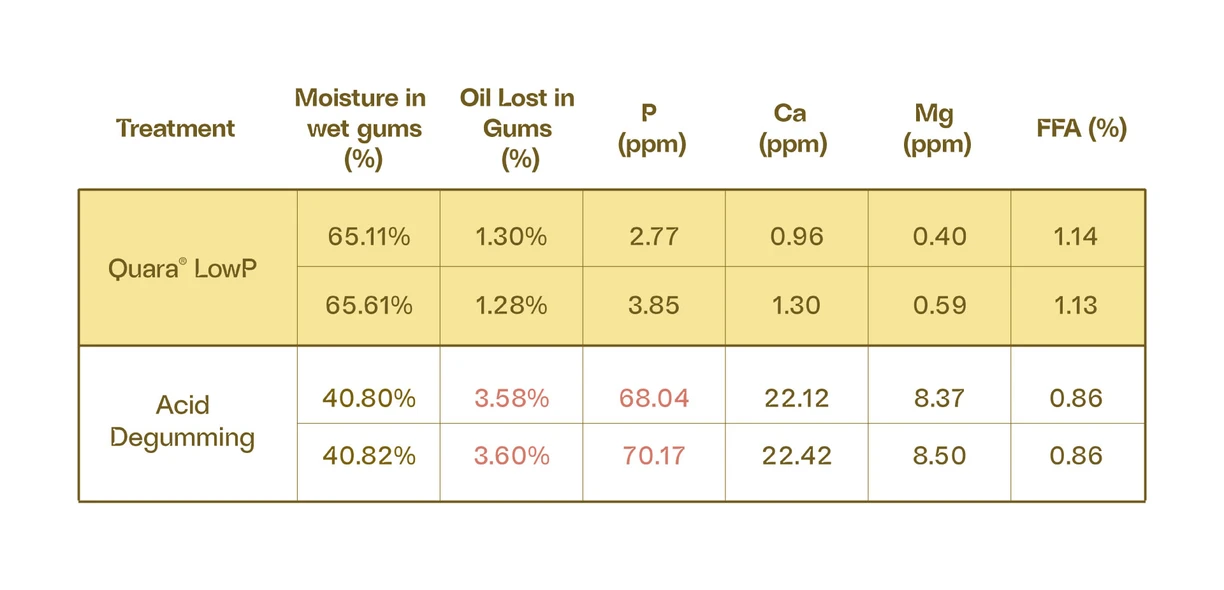
In one of the lab trials, we conducted a comparison between acid degumming and deep degumming assisted by one of Novonesis’ enzyme solutions, Quara® LowP.
The feedstock was a crude mixed rapeseed/canola oil at 396ppm P, 199ppm Ca, and 0.88% FFA. (Canola oil is specifically derived from a special variety of rapeseed.)
Quara® LowP outperforms acid degumming
When compared to acid degumming, enzymatic deep degumming with Quara® LowP has shown superior performance in phosphorus and metals reduction, with 1.4% less oil lost in gums. (Table 1)
1.4%
less oil lost in gums observed with enzymatic deep degumming using Quara® LowP
Table 1.
Comparison: Reduction of P and metals after acid degumming and enzymatic degumming with Quara® LowP on North American canola oil (50% pressed, 50% extracted blend).
Results can vary depending on the feedstock, please contact our technical team to explore all results available.
Driving innovation in rapeseed oil processing
Rapeseed oil continues to be a significant feedstock in Europe's vegetable oil production, with degumming playing a vital role in enhancing its quality and quantity. Enzymatic degumming has paved the way for more efficient and sustainable processing methods, offering improved yields and superior oil quality.
Globally, over 200 plants utilize Novonesis enzymes in their oil processes
More than a hundred plants worldwide rely on Novonesis enzymes in their oil processes, supported by Novonesis’s global network of technical specialists and state-of-the-art lab and pilot facilities. In 2022, Novonesis established the world’s first Degumming Center of Excellence in Brazil, together with technology partner BR Process. There, customers can test feedstocks and develop their production process to gain better performance.
As the industry evolves, Novonesis remains committed to ongoing innovation and development of its enzymatic solutions to meet the growing demand for high-quality rapeseed oil, and to help producers improve profitability.
To learn more about the various enzymatic degumming routes and how we can support you, please click here, or contact us for a consultation.
What could this mean for your business?
To view this form, update your cookie preferences
This form is hidden because Marketing Cookies are turned off. You can enable them in your cookie settings to continue.