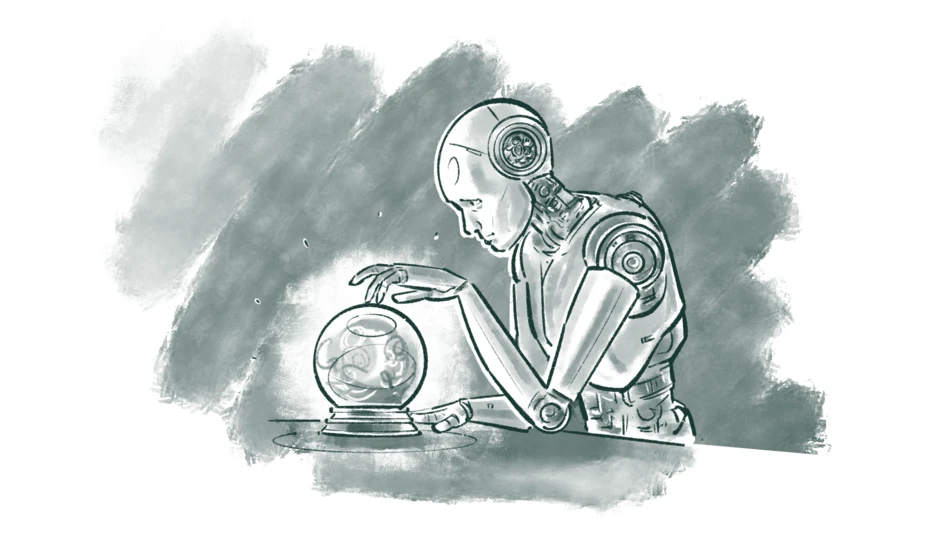
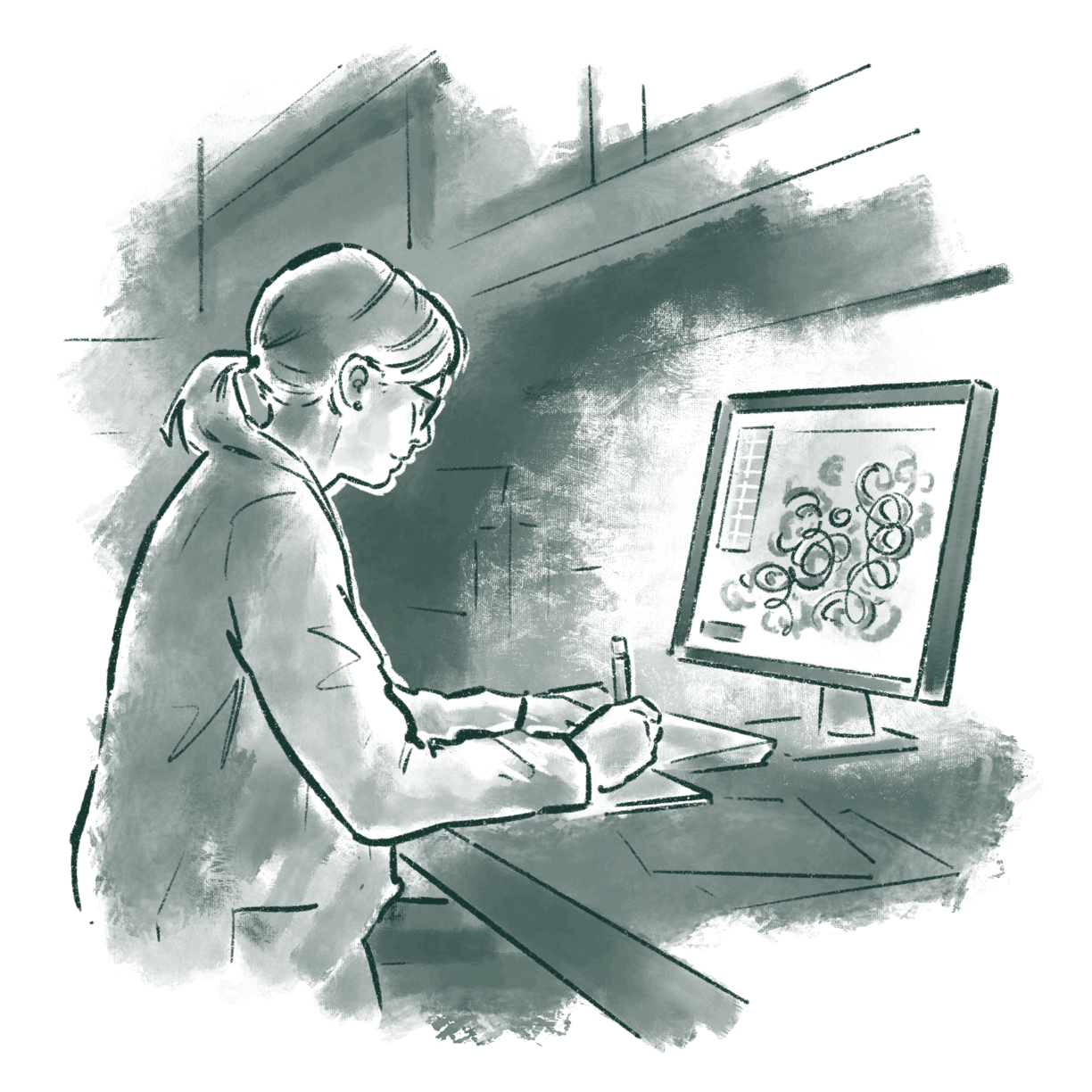
In this article we will focus on how the classic image of microscopes, petri dishes, and lab coats only tells part of the story. Modern biology now relies on artificial intelligence, supercomputers, and advanced technologies to explore details once unreachable, uncover patterns invisible to the human eye, and design solutions that were once unimaginable.
When computers and AI first entered the biology lab
How long do you think computers and AI have been part of biology? Ten years? Twenty? Thirty? Try seventy-five!
It was 1946, and IBM had just unveiled the 602A, an electromechanical machine the size of a small desk, full of whirring gears and clattering switches. It was not a computer in the modern sense, but for its time, it was close to one. Scientists could feed it numbers, and in seconds it would spit out results that once took teams of researchers days to calculate by hand.
By the early 1950s, machines like the IBM 602A had found their way into biology. In fields like applied genetics 1, researchers began leaning on these electromechanical workhorses to do statistical calculations. Suddenly, scientists were free to focus on thinking about what the numbers meant, rather than spending weeks just crunching them.
And yet, these early machines were still just tools. They followed instructions blindly, without any “intelligence” of their own.
That began to change in the 1960s.
Modern biology relies on AI and super computers.
At Stanford University in the mid-1960s, a small team of chemists, computer scientists, and geneticists came together to tackle a problem that had puzzled researchers for decades: how to figure out the shapes of molecules. Molecules are the building blocks of chemistry and life itself, but at the time, determining their structure was an agonizingly slow process. Researchers relied on tedious manual calculations, sketches, and endless cross-checks, often spending weeks or months just to solve the shape of a single molecule.
In 1965, the team built DENDRAL, one of the world’s first successful AI programs. DENDRAL was not “intelligent” in the way modern AI is, but it could mimic expert reasoning. Scientists taught it the dos and don’ts of chemistry, such as which bonds are stable, which are likely to break, and how molecules tend to behave. Using these rules, DENDRAL could test possibilities far faster than any human could. Where researchers once struggled for weeks, DENDRAL could narrow down the likely shapes in just a few hours.
For chemists, it felt like a superpower. But it wasn’t just chemists who were intrigued. Biologists were watching closely, realizing that as their field moved deeper into the molecular world, they would soon face the same challenges.
Still, DENDRAL and later systems like MYCIN and SUMEX-AIM, had their limits. These primitive AI tools were brilliant but strictly rule-bound. They could only do what experts explicitly taught them. As biology started generating higher volumes and complexity of information, these AI tools began to show their limitations, paving the way for a new generation of AI.
Biology needed something different — systems that could learn from the data itself, spot patterns humans could not see, and make predictions we could not guess. Among all this complexity, one challenge stood out above the rest: understanding proteins.
Solving the protein puzzle
Solving the protein puzzle
Inside every living cell, molecular biologists were uncovering an intricate world of tiny components: genes, DNA, enzymes, and metabolites. However, at the heart of almost everything they studied, they kept finding proteins.
For most of us, the word protein brings to mind nutrition labels or fitness plans. It is just another food group for us, like carbohydrates or fats. But in biology, proteins are so much more than something we eat.
Proteins are the molecular machines of life. They build our cells, repair damaged tissues, transport oxygen through our blood, send chemical signals between cells, and drive thousands of reactions that keep us alive. Every heartbeat, every blink, every immune response in your body — proteins make it happen.
Ever wondered why we need to eat proteins in the first place? It is because proteins are built from smaller chemical units called amino acids — think of them as tiny LEGO blocks of life. There are 20 different amino acids, and by linking them together in different sequences, your body can build thousands of unique proteins, each with its own role to play.
Building with amino acid is like building with lego.
Understanding protein shapes became one of biology’s most urgent goals. But this turned out to be one of its hardest problems. For most of the 20th century, scientists relied on slow, painstaking techniques like X-ray crystallography, nuclear magnetic resonance (NMR), and mass spectrometry to determine these shapes.
These methods are still used today because they produce incredibly precise data, but back then they were the only tools available, and solving the structure of a single protein could take months or even years. And yet, thousands of scientists around the world kept at it. Why? Because they understood something vital: